Noble Bloodlines
Rinn remembered no warm home, no gentle hand, no lullaby to soften the nights. She remembered only the alleys of Asyen. Cold stone, colder rain and the faces of people who refused to look at her. They sneered at her, muttering orphan, stray, gutter-elf.
At an early age she learned the most important lesson of the streets:
No one protects you. You protect yourself.
It was winter when it happened. A drunken man cornered her behind a tannery, thinking her too small to resist, too frightened to fight. He reached for her with a slurred whisper. Rinn acted before she even understood the choice she was making. She grabbed the knife from his belt, drove it upward, and felt the warmth of his blood run down her wrist as he collapsed.
She stared at the blade, trembling—not from guilt, but from recognition.
She had saved herself.
Something awakened inside her:
a storm with no lightning, a wind with no mercy.
I. The Girl Who Learned to Steal the Sea
In the years that followed, Rinn carved a space for herself in the cracks between society’s cobblestones. She learned to steal without being seen, run without being caught, and disappear before anyone knew she was missing. But the streets had limits, and Rinn’s hunger did not.
Her chance came when she tried to pilfer food from a cargo ship anchored at the docks. She didn’t know the ship belonged to the Driftmarsh Crew, a ruthless band of smugglers, thieves, and fledgling pirates.
They caught her by the ankle as she attempted her escape.
The crew’s captain, a scarred elf named Vaelith, watched her spit and snarl like a wild creature, refusing to beg for her life. Something in her defiance reminded him of himself.
“Teach her,” he ordered the crew.
Rinn was dragged back aboard the ship. At the time, she did not know she had been thrust into the world she would one day master.
She caught on fast—faster than the crew expected—learning to navigate both the water and the hidden currents. By the time she reached adulthood, she could slip a lock, steal a fortune, or kill a man with equal ease. She was small, quick and able to slink back into the shadows unseen.
Rinn became the Driftmarsh Crew’s most valuable asset.
II. The Night the Wind Turned Black
Vaelith did not plan to betray her.
But a merchant with too much gold and too little sense offered him a fortune, to hand Rinn over—alive...
When Rinn was dragged in chains below deck, she asked only one question:
“Why?”
Vaelith answered honestly. “Because I can.”
There were no cries for help, she did not beg to be let go…She only listened, a storm was gathering outside—the howl of the wind, the churn of the waves. It was time she too became a storm, Vaelith betrayal would not go unpunished
And she slipped the lock on her chains.
What followed was not a mutiny.
It was a massacre.
Unleashed inside a wooden coffin floating on the sea. By dawn the deck was slick with blood, and Rinn stood at the helm, wind tearing through her hair as the sun rose behind her.
III. Birth of the Blackwind
The surviving crew, those she spared, swore loyalty rather than face the depths. Rinn accepted their oaths, but not their old name. The Driftmarsh Crew was dead. She had seen to that.
She christened her new vessel Blackwind, after the storm that answered her rage.
Under her command they did not merely steal—they dominated.
They smuggled goods through elven courts, sold secrets to kings, ferried weapons to rebellions. The rich were robbed, powerful outwitted, and merchant guilds toppled. They left their victims with nothing but a black rose pinned to what was left, a calling card known across every coast.
Fortunes that were built on arrogance became their feast. Empires with corrupt advisors became their playground. And every coin she collected was proof that the world had been wrong to cast her aside.
The Dark Thread Sewn Beneath the Legend
Though Rinn became a terror of the seas, piracy alone did not build the fortune that raised House Blackwind. That was only the surface. Beneath it lay something colder, more calculated, and infinitely more destructive. She cultivated a quieter empire inland—one built on contracts, credit, and carefully engineered desperation.
It began when she discovered how deeply the Dwarven settlements depended on elven merchants for tools, food supplements, and trade goods. Rinn saw opportunity where others simply saw commerce.
She sent her agents. They were smiling, polite, and unfailingly reasonable.
- Discounted tools
- Extended credit
- Backlogged interest “forgiven” if payments were timely
- Tool shipments delivered even in harsh seasons
The Dwarves accepted. Why wouldn’t they? It was a kindness they believed the surface had never shown them.
But every contract carried a hidden clause, every ledger a quiet trap. Interest rates that doubled unexpectedly. Penalties for late shipments caused by storms. Additional "fees" for protection, transport, or handling.
By the time the Dwarves realized they were drowning in debt, it was too late her agents said with sympathetic smiles,
“If you cannot pay in coin,” they said gently, “you may repay in labor.”
What was meant to be one season of work became three. Three became ten. Ten became a lifetime. Debt never stopped accumulating.
And so the mines were born, not through conquest, through debt. Rinn never needed chains. She used their dependence on her. The Elven lords later took credit for the mines, for their “Partnership” with the Dwarven workforce.
Rinn became a legend— the orphan who killed her first man before she reached adulthood, the Queen who bent storms to her will, the shadow the light couldn’t touch.
By the time she died, The Blackwind was no longer just a single ship. It was a fleet of hundreds of ships, a dynasty that echoed through time. Rinn earned House Blackwind a seat at the Great Courts of Wrylith ensuring her house would last for centuries to follow.
Her seat was earned not from noble lineage, but a fierce cunning, and a promise that no one would ever again force another child like her to kneel. House Blackwind became a bastion, to the damned and the lost.
Still Whispered in old taverns and on forgotten docksides is their creed…
Secrets buy silence,
Debt buys obedience,
and the sea buries the rest...
All pay in the end.
The Phoenix House
Chapter I — The Cursed Seer
Cordelia was born blind, yet she saw more than any mortal before or after her. Her eyes, though pale and unseeing, burned inward with the fire of prophecy. She saw the rise and ruin of nations yet unborn, the faces of kings not yet conceived, and the shadows of wars still centuries away.
Her visions were relentless, a curse that granted knowledge while shredding her peace of mind.
But Cordelia bore the burden with grace.
Where others feared what might come, she sought to prevent it.
Beside her stood Rivermoon, a warrior of unmatched heart and strength.
Together, they forged the foundation of what would become House Caelith, a house built not on ambition, but on protection, a beacon to the tribes who wished to keep the old ways of cooperation, honor, and shared land.
Chapter II — Two Houses Rose Together
In the earliest days of the First Age, two houses ascended:
House Wrylith, under Saelyra, who shaped the world with her tongue of silver.
House Caelith, under Cordelia and Rivermoon, who shaped it with truth, sacrifice, and visions of what could be.
For a time, the two houses stood as equals, one guiding fate, the other guarding against its darkest possibilities.
Cordelia saw further than any.
And what she saw terrified her.
She warned the tribes:
“Saelyra’s words will bind you.
Her promises will chain you.
Her rule will bleed your futures dry.”
Some listened.
Others didn’t.
Wrylith’s influence spread like wildfire, beautiful from a distance and ruinous up close.
Cordelia and Rivermoon gathered those who would not bow, the loyal, the hopeful, and the frightened. Together, they forged an alliance of tribes determined to resist the growing shadow of Wrylith dominion.
The world was young, but already, it trembled.
Chapter III — The First Great War
When diplomacy failed, when Wrylith decrees were pressed too far, the alliance had no choice. War had erupted, in 6,274 A.P. it was the first true war since the gods had left.
On the eve before the final battle, as the alliance gathered beneath a sky already restless with falling embers, Rivermoon knelt before Cordelia alone. She spoke then of death. Of stars burning. Of a future where neither of them would see another dawn.
Rivermoon listened in silence. When she finished, he rose and sat beside her.
“Then hear this, my love,” he said, in a gentle voice. “I will not fight to survive your visions. I will fight to defy them.”
He stood and looked toward the gathered tribes and spoke, his voice as steady as stone.
“If fate demands our end, then let it find us standing. If history remembers us only as corpses, then let our corpses be the walls, in which others can hide behind to live free.”
History remembered it as The Battle of Falling Stars, for meteors streaked across the night sky as the armies clashed, an omen Cordelia had foreseen and Rivermoon had sworn to face unflinching.
The battle raged for three days.
On the final dawn, Cordelia’s last vision came true:
She and Rivermoon fell together, surrounded by Wrylith blades.
They fought until their final breath, Cordelia whispering warnings even as she fell, Rivermoon standing above her like an iron tower refusing to break.
Saelyra Wrylith ordered their bodies displayed publicly.
They were raised upon iron frames at the heart of the field, visible for leagues.
Cordelia’s head was tilted skyward, as if still watching the heavens that had betrayed her. Rivermoon’s hands remained clenched even in death, fingers torn and bloodied, as though he had tried to tear the world apart to shield her.
The executions of their children followed.
Not all at once.
One by one, before the gathered tribes.
Some screamed. Some did not. The youngest child present did not understand why the crowd would not meet his gaze.
That day, something broke.
Three allied clans withdrew their banners in silence. Two oaths that were sworn to Saelyra were severed. And among the soldiers ordered to stand witness, more than one lowered their weapon and wept.
Wrylith declared victory, unknowing they had just sown the seeds of their downfall.
For a time, the First Age belonged to them.
Chapter IV — The Hidden Child
But history, as always, is shaped by what survives.
Unbeknownst to Wrylith, one child escaped the slaughter.
Adwar Caelith, youngest son of Cordelia and Rivermoon.
He was spirited away in the chaos by a loyal retainer and hidden in the deep wilds. For years he was believed dead. For years he lived in the shadows, half-starved but burning with two inherited gifts:
- His mother’s cursed sight
- His father’s unmatched strength of arm
His visions were ragged and uncontrolled, coming in flashes, fire, thrones breaking, a serpent with two heads devouring itself, the fall of a silver crown. But the meaning was clear:
Wrylith’s reign would end by his line.
Adwar did not seek a throne.
He sought justice.
He sought restoration.
He sought to honor the blood spilled on the Field of Stars.
He trained. He traveled. He gathered those wronged by Wrylith rule.
And piece by piece, over the course of decades, House Caelith was reborn, not yet as a house, but as a movement.
A phoenix rising from the ashes.
Chapter V — The Vengeance of Caelith
Generations passed.
Each carried Adwar’s vow forward.
As Wrylith’s grip on the world grew brittle with age, Caelith’s influence spread quietly and steadily, like roots pressing through stone. They learned Wrylith’s methods and turned them inward. They studied Wrylith’s laws and unraveled them. They exposed deceptions long mistaken for governance, draining strength not through open war, but through revelation.
Three hundred years after the battle, the reckoning came.
Through truth, the very instrument Saelyra had once mastered and bent.
The world saw Wrylith clearly at last: rulers of necessity, hoarders of authority and manipulators of fate. The architects of suffering whenever it proved convenient.
When the great collapse came, Caelith did not rise as conquerors, but as liberators.
Wrylith did not fall into ruin. They simply fell.
Chapter VI — The Rivalry Eternal
Thousands of years have passed.
Nations have risen and fallen.
Other noble houses have taken the stage.
But the enmity between Wrylith and Caelith remains unbroken.
Caelith remembers the slaughter.
Wrylith remembers the rebellion.
And both houses know a simple, eternal truth:
Their stories can never be separated.
House Wrylith speaks in silver.
House Caelith sees through it.
The phoenix and the forked tongue, rivals since the crown was donned, and rivals they shall remain until prophecy itself grows silent.
Creed
"In ruin, we smolder.
In struggle, we ignite.
In death, we ascend.
Ours is the crown reborn
Ours is the fire eternal."
Ahmri of House Maedhros — The Chainbreaker’s Daughter
As a child, Ahmri had long wondered what the small silver key was meant to open, but she never found the courage to ask. Her father, Allistar, wore it on a thin chain tucked beneath his shirt, where it rested over his heart.
Allistar had been born a common Elf, neither wealthy nor destitute, but he rose through the ranks of commerce with uncommon speed. With no wife and only a daughter to raise, he poured everything into his business ventures. Ahmri stayed completely devoted and followed in his footsteps.
When she was still young, Allistar placed the key around her neck and told her,
“This key will guide you to the answers you seek, my child.”
She did not understand then, but the words never left her.
The last night Allistar and Ahmri spoke, he said he would be away on business only briefly. But days turned to weeks, weeks turned to months, and Allistar did not return.
Half a year later, while managing her father’s flagship shop, The Shiny Rabbit, Ahmri found a concealed door she had never noticed before.
The key fit perfectly.
Inside was a secret room filled wall-to-wall with chests, drawers, and small locked compartments.
The first box she opened revealed a cascade of gemstones in colors she had never known existed.
The second, a hand-carved box no larger than a book, contained a sealed envelope bearing the crest of House Maedhros, a sigil she had only ever seen from afar.
With trembling hands, Ahmri broke the wax and read.
The Letter of Allistar Maedhros
My Dearest Daughter,
If you are reading this, then I am dead. I am sorry to leave you alone, but the choice was not mine to make.
Your mother is coming for you.
Her true name is Livan Silverstorm.
I met her when I was young, and her beauty masked a will sharper than steel. She was born to nobility, daughter of Ayre and Ailmer Silverstorm, rulers of the underground mines. She swore she despised the chains her parents forged and would never aid in the enslavement of the Dwarves. I believed her. I loved her.
Together we founded the Silver Rabbit. Your grandfather Ayre funded our beginnings, and success followed swiftly.
But power changes people.
When you were born, Livan decided the only path forward was dominion. I watched her kill Queen Ailmer with my own eyes. Ayre fled. Livan took the throne.
I bargained for your safety. I paid tribute to keep her distant. But ambition does not sleep, and blood calls to blood. She will claim you, not as a daughter, but as an asset.
This fortune is not for comfort. It is for escape.
If I failed, run. Hide. Build. Survive. Live free.
—Your Father
The Flight from the Silver Queen
Ahmri wept until the parchment blurred, grief hollowing her chest. But grief alone could not save her.
Within days, whispers reached her ears. Black-sealed contracts. Silent observers in the streets. A noble convoy making inquiries under false names.
Livan had come.
Ahmri did not confront her mother. She did not plead.
She vanished.
In a single night, Ahmri abandoned her public life, shuttered accounts, burned ledgers, and scattered false trails across three cities. The Shiny Rabbit remained open, thriving even, but its mistress was gone.
To the world, Ahmri Maedhros had dissolved into rumor.
Behind the scenes, she followed her father’s final instruction.
The Rise of the Chainbreaker
Ahmri rebuilt her father’s network in shadow. Each new shop masked a safehouse. Each caravan concealed fugitives. Each contract carried coded messages for the Dwarven resistance.
Coin became her weapon. Secrecy her shield.
Livan hunted her relentlessly, but power rooted in fear proved clumsy against patience and planning. Supply lines faltered. Tribute vanished. Rebellions flared and survived where they should have starved.
Ahmri never drew a blade against her mother.
She did something far worse.
She made Livan irrelevant.
They named her Chainbreaker, not for shattering iron with steel, but for dismantling tyranny ledger by ledger, deal by deal. Chains fell quietly in her wake, unnoticed until they were gone.
House Maedhros rose not through conquest, but through escape, endurance, and defiance bought with courage.
And Ahmri kept her father’s promise:
Creed
No slave forgotten.
No tyrant unchallenged.
No chain unbroken.
Placeholder: Add Rak'gan history here.
Creed
(Put House Rak'gan’s creed here.)
After the Fall
I. After the Fall
The War of the Endless Night did not begin with banners or armies.
It began with a scream from the heavens.
When Vy’kyl fell and his blood soaked the world, death lost its hold on the dead. Battlefields did not cool. The fallen rose as echoes, as hunger given shape. Night lengthened, and the sun grew dim, as if light itself recoiled.
Armies still marched and kingdoms still quarreled, but these conflicts were of little consequence compared to the rising tide. A truer war had begun, one that would be fought everywhere. No one could escape it. The living learned what terror truly was: death no longer brought peace, only an unnatural hunger.
II. Aurelian Vaeloris
In the years after the Fall of Vy’kyl, many sought to cull the undead at any cost.
Aurelian Vaeloris sought to outlast them.
He learned quickly that healing the living was not enough. The dead would rise if left unattended, returning if their bodies were not prepared properly. Mercy now required grim discipline. Corpses had to be sanctified and burned.
Aurelian knelt among the fallen not to pray for miracles, but to deny the darkness its harvest. In fields choked with corpses, he stayed, treating wounds, performing rites, and learning which deaths birthed horrors and which did not.
He recorded everything. His work was exhausting, thankless, and necessary.
III. Seria Trinagel
Where Aurelian brought light, Seria brought resolve.
She had been a warrior long before she met him, sworn to hold against the undead. She kept that oath long after the horns fell silent and messengers stopped coming. When the walls finally fell, she did not retreat with the others.
She stayed until there was no one left to protect.
In that aftermath, Seria learned the lesson that would define her life:
Survival begins where obedience ends.
She walked away from the ruins of her home carrying no banner. Victory, she learned, was not measured in ground held, but in the lives that continued beyond that night.
When she found Aurelian tending the wounded on a road with no guard, she recognized a different kind of resolve.
Seria did not join him for glory. She joined to buy him time, so rites could be performed and the dead would not rise. She stood at the edge of the lantern’s glow, unyielding, making the darkness falter.
Where Aurelian denied death through mercy and rite, Seria denied it through discipline and will. Together, they formed a boundary the darkness could not cross.
IV. Where Others Fell, They Endured
Some relied on sanctified ground.
Others trusted divine wards that weakened over time.
Some clung to sacred temples while the dead waited.
Entire sacred orders, noble bloodlines, and whole cities vanished within a generation.
Aurelian and Seria refused to remain in one place for long. They never allowed undead concentrations to form unchecked. They burned fields when needed, sealed crypts others feared to disturb, and taught their followers to abandon holy ground if it meant saving lives.
This is why they survived where others did not.
V. The Bond Forged in the Long Night
Their bond formed not in peace, but in repetition, like a dance performed every night.
Night after night.
They learned one another’s limits intimately. Seria learned why Aurelian refused to abandon the dying. Aurelian learned why Seria would hold the line regardless of cost.
Neither tried to change the other.
They married beneath a sky still bruised. There was no ceremony. Their lives continued as always.
From this union came the Vaeloris bloodline, sworn to be the light that would guide the living.
VI. The First Seals of Light
As the war dragged on, it became clear that endurance alone would not be enough.
Through years spent tending the fallen, Aurelian’s records revealed a pattern. Some places bled undeath endlessly. Others could be stilled only briefly, and only through layered rites demanding constant vigilance.
The dead were not merely rising.
They were being called back.
Working alongside the last surviving clerics, wardens, and scholars, Aurelian devised a ritual known as The Seals of First Dawn.
Seria led the expeditions to place them.
Each seal demanded sacrifice, not only of blood, but of memory. Those who laid them swore never to forget the names bound within, nor the cost paid to keep the living safe.
Some seals were set beneath cities that still breathed. Others were buried in mass graves no one wished to revisit, where the ground itself remembered screams.
The seals did not destroy the undead.
They denied them return.
When the final seal was placed, the night did not end all at once.
But it began to loosen its grip.
For the first time in nearly three hundred years, the dead stayed dead.
VII. Dawn, and the Acceptance of Burden
When the Seals were set and darkness receded, the world rushed to crown its saviors.
Rulers gathered in sunlit halls, arguing borders and victories, eager to turn survival into legitimacy.
Aurelian and Seria accepted elevation carefully.
Their demands were precise.
Any who tampered with the seals would be named an enemy not only of Vaeloris, but of the world’s fragile peace.
The rulers agreed.
They remembered what it had cost to bring the light back.
They understood that some powers were too dangerous to be left without guardians.
Creed
"We gather the broken beneath our wings.
We kindle hope where the world has forgotten it."
For even the faintest spark can guide the lost to dawn."
Rurik Vangarn — The One Who Broke the Chains
Rurik Vangarn was built like a bull fit for labor or war, however he was not born to the mines. He was raised in the high hills of the Stoneward Clans, among dwarves who still remembered open skies and clean forges. He learned the craft of shaping iron and how to swing an ax.
He married Dehlia Stonewright young, not for alliance or advantage, but because she saw the world as he did. A simple life was all they both wanted. Their life was measured and honest. They had no hunger for banners, or for songs sung about them.
That changed when Dehlia took contracts below.
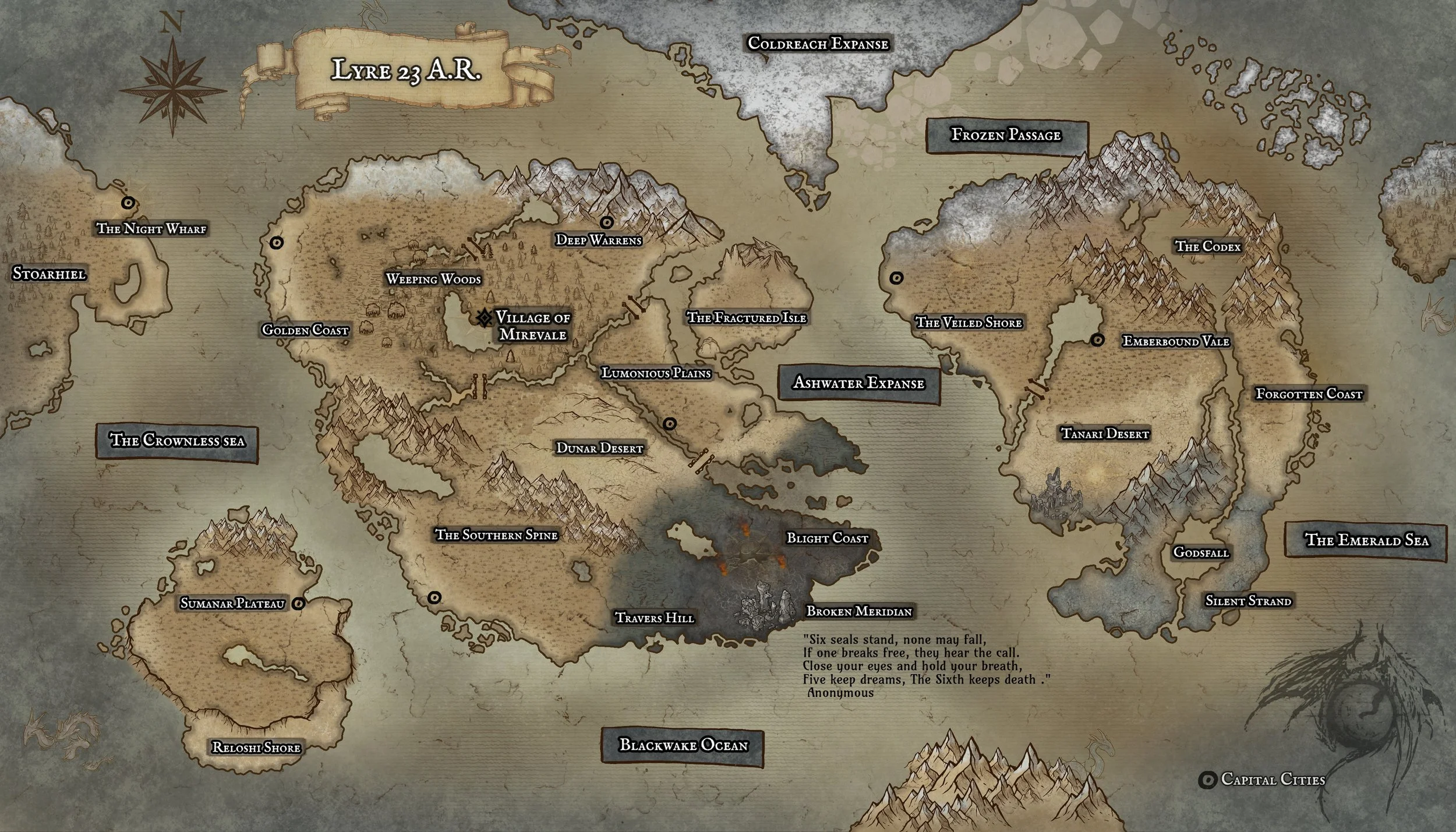
The Deep Warrens were spoken of as an opportunity. Contracts with guaranteed pay. Mutual benefit. Rurik went with her once, intending to inspect their claims and return to the surface with clear conscience.
He saw dwarves bound not by chains, but by debt and isolation. He saw generations buried underground, not dead, but forgotten. He saw Elven overseers who spoke of contracts and quotas while enforcing obedience.
Rurik returned to the surface alone.
Dehlia stayed below, by choice.
She wrote to him at first. Short messages. Practical concerns. Stone quality. Structural strain. Then suddenly the letters stopped.
When Rurik went back for her, he was stopped at the entrance to the mine and told there was a delay, a clerical dispute, a revised contract.
He would not stand idle while his wife was below. He forced his way through the gate.
The guards were not prepared for resistance from a dwarf. Steel met steel. In the struggle, an Elven blade bit Rurik’s left arm deep. He wrapped the wound in his cloak, knocked the elf out with his right hand, and continued forward. He found Dehlia alive.
After returning home, Rurik sought care for his left arm. Unfortunately infection had set in and there was no choice: he would lose most of his arm.
The Quiet Breaking
Rurik did not declare war.
He did not rally clans or strike banners.
Instead, he learned.
He studied the contracts that governed the Deep Warrens. He traced the flow of ore, food, and debt. He learned which tunnels were essential and which were redundant. He learned which overseers understood stone and which were oblivious.
Dehlia returned below, openly this time, as a stonewright under new terms. Others followed, not rebels, specialists, inspectors and engineers.
The mines slowed. Shipments arrived late. Support failures forced evacuations. Quotas became impossible to meet without risk.
Each failure could be explained.
The Elves eventually issued corrections, penalties, and then threats.
None worked.
When shipments stalled and contracts unraveled, the Elven authorities did what they always had. They tightened control. They sealed tunnels. They armed overseers openly and declared the mines essential to regional stability.
Dwarves who attempted to leave were detained “for their own protection.” Those who resisted vanished into unmarked shafts.
The language of law gave way to force.
That was when Rurik Vangarn returned to the Deep Warrens for a final time.
This time he did not come alone.
For years, House Maedhros had watched the flow of ore, coin, and contract. They understood trade not as exchange, but as leverage. Where others saw rebellion brewing, Maedhros saw an opportunity to break an unbalanced market permanently.
Weapons arrived disguised as tools. Coin flowed through intermediaries who never set foot in the mines. No banners were raised. No promises spoken aloud.
The Deep Warrens armed themselves quietly.
Dehlia coordinated from within. Rurik from outside.
She mapped the tunnels, identified choke points, and load-bearing arteries that could be brought down without burying their own. She trained the other Dwarves about the terrain. Every dwarf learned where to stand, when to vanish, and when to strike.
When the Elves finally moved to retake full control, they found the mines no longer answered to them.
The Rebellion of Stone and Steel
The uprising did not begin with a shout.
It began with silence.
Elven patrols entered shafts that no longer echoed. Orders were given and received no response. Then the tunnels shifted.
The shaft supports collapsed behind advancing forces. Barricades rose where open corridors had been hours before. Dwarves struck in groups, withdrawing before counterattack, returning where defenses thinned.
Rurik led where resistance was thickest. One-handed, armored in leathers and iron, he fought without flourish. His presence steadied the line. His decisions ended engagements before they became slaughter.
Dehlia commanded the deeper levels, directing collapses and reroutes with the precision of a master mason. Elven reinforcements became lost, isolated, and exhausted. Stone dust choked signals, as if the mountain itself turned against them.
When surface forces descended in earnest, they were met not by workers, but by a resistance that knew every tangled hall of the Warrens.
The fighting lasted three days.
On the fourth, the Elves withdrew. Not defeated in battle, but broken in position. The cost of holding the mines had become greater than their value.
House Maedhros ensured the lesson spread quickly. Trade routes were shifted. Contracts dissolved. The Deep Warrens were quietly declared unprofitable.
The Iron Aftermath
The Deep Warrens were not the only place Rurik Vangarn would see walk free.
Word spread faster than any imagined. Dwarves still trapped in distant mines, lesser holds, and forgotten extraction sites sent quiet messages through old trade routes.
Rurik answered each in turn.
Some mines fell without force. Most required bloodshed.
All were dismantled in the end.
By the end of his campaigns, no known dwarven laborhold bound by debt remained unchallenged. Some were closed forever. Others were reclaimed and restructured.
The age of silent bondage ended not in a single rebellion, but in a succession of deliberate acts.
When the fighting ceased, Rurik ordered no executions.
Elven overseers were expelled, stripped of authority and escorted to the surface. Those who had committed atrocities were delivered to the High Courts, where testimony supplied by House Maedhros ensured no ledger or precedent could erase their crimes.
The contracts were turned against those who had hidden cruelty within them.
The Noble Courts could no longer ignore the scale of what had been done.
For the liberation of dwarves from their bondage, and for the exposure and dismantling of House Blackwind’s subterranean holdings, Rurik Vangarn and Dehlia were summoned before the High Courts.
There, they were awarded lands vast enough to sustain an empire, and granted a seat on the High Courts.
House Vangarn was formally recognized.
The Deep Warrens were reopened under his rule.
Contracts were rewritten in plain language. Wages were guaranteed. Rotations were humane. Education and apprenticeship replaced inherited obligation.
Entire clans returned underground by choice, reclaiming stone with pride rather than fear. Surface trade flourished, and the ore of the Deep Warrens became known not just for its quality, but for the integrity behind it.
The mountain was made honest again.
Rurik ruled from the Deep Warrens until his death, never building a palace, never moving his seat. He walked the tunnels daily, his one hand on stone. Dehlia stood beside him always, overseeing construction, training, and the careful balance.
They had many children together. She outlived him by nearly two decades.
And shortly before her passing she recorded the final line in their chronicle:
“I have lived long enough to miss him every morning,
In that small ordinary ache,
I found a life I would choose again.
For we were not made perfect,
We made hard choices.
But we helped people,
In the end, that was enough.”
Creed
"We do not kneel.
We do not yield.
We rise as one,
With hammer in hand."
Kalvia Ky’Vok — The Battle Maiden of the Last Hope
Kalvia Ky’Vok was the third-born daughter of Katrin and Felron Ky’Vok, honest and well-loved orcish blacksmiths of the village of Vellir. Felron shaped iron, Katrin engaged in trade, and together they shaped a home filled with warmth.
But Kalvia would remember little of it.
Before her fourth name-day, a Blight swept across the plains. Villages fell sickened, families broke, and Vellir burned beneath a fever no healer could cure. When Clerics of the Dawn arrived from Travers Hill, they found many had already perished, but there were a handful of surviving children.
Kalvia was among them.
The clerics escorted the orphans back through snow to their monastery, giving them food, shelter, and a future carved from mercy. The scars left by the Blight never faded. Instead, they became the roots from which Kalvia’s strength grew.
I. The Orphan Who Would Not Yield
Kalvia came of age within the stone walls of the monastery, her strength shaped as much by discipline as by her faith. While others devoted themselves solely to study, she pursued both scripture and sword with equal intensity.
She trained until her hands split and bled, refusing to yield, leaving many of her peers bruised and humbled by her resolve.
When nights grew long and memory turned cold, it only hardened her purpose.
Fear found no hold in her.
Shortly after her thirteenth nameday she met Lyim, a human boy a few years her senior. Together they studied the gods: Kalvia gave her devotion to Valkyr, Lyim to Faye. Their paths diverged in faith, but their bond endured.
Years passed. Kalvia emerged a formidable orcish woman, strong-armed and keen-eyed, her purpose honed sharper than any blade the monastery could forge.
When the time came, she did not hesitate.
She left the safety of stone and prayer behind and turned her gaze toward the Blighted Lands.
Before she departed, Kalvia entrusted Travers Hill to Lyim’s care. The monastery and its people would remain under his protection while she was gone, guarded by faith rather than steel.
They parted without ceremony, bound not by shared paths, but by shared purpose.
II. Into the Blighted Lands
The Blighted Lands were a realm of ruins. Storms devoured caravans whole, leaving only splintered wheels and bleached bone behind. Creatures born of hunger stalked the dark, twisted remnants of things that had once lived.
The air itself seemed hostile to breath.
Kalvia entered these lands not seeking glory, nor martyrdom, but a trial.
She fought where law had fled and where banners no longer meant safety. Bandits learned to fear the sound of her boots. Monsters learned that not all prey fled.
Three years passed.
Around her gathered soldiers whose armies had vanished, warriors who had outlived their causes, and men and women who had nothing left but the strength in their hands.
Kalvia did not promise them riches or redemption.
She promised hope.
From that work, she forged them into The Last Hope.
They restored order where none remained, not through conquest, but through presence. Kalvia stood always at their front, blade drawn, shield raised, unbroken and unbowed.
III. The Night the Clerics Came
The night Kalvia’s past returned, the camp was quiet.
Fires burned low. Soldiers slept or sharpened blades by habit rather than need. Kalvia remained awake, reviewing supply ledgers by lantern light, weighing routes and rations with the same care she once reserved for battle.
Darren Orin’Oak, her second-in-command, brought word of clerics bearing the sigil of the Dawn. They refused food and water and asked only for Kalvia.
Among them was Lyim.
From him came the account of the fall of Travers Hill. The Legion of the Freemarch descended with iron fist and deliberate cruelty. Villages were burned to deny refuge. Men enslaved to break resistance. Children slaughtered to instill obedience.
Kalvia listened without interruption.
When the account was finished, she gave her answer.
The march began that night.
IV. The Battle for Travers Hill
Before dawn touched the sky, The Last Hope crested the ridge overlooking Travers Hill.
Smoke rose from ruined homes in slow coils. Cries drifted through the valley like echoes of violence not yet spent.
Before Kalvia Ky’Vok ordered the advance, she spoke:
“At the darkest hour, we remain.
When hope is lost, we endure.
When the world calls, we rise,
not for glory, not for reward,
but so that others may see the dawn.”
Steel rang against steel. Fire consumed the palisades. Wherever Kalvia advanced, resistance collapsed. Wherever she held ground, the line endured.
In the heart of the hold, she faced the Freemarch warlord alone.
Strength met resilience. Fury met wisdom.
Kalvia fell, struck down and disarmed, her breath driven from her.
The warlord raised his weapon to end it.
V. The Spear of Valkyr
Light split the darkness.
Witnesses would later agree on only one truth: the moment bore divine recognition.
Kalvia Ky’Vok rose, not as a supplicant, but as judgment given form.
A spear of white fire appeared in her grasp. The warlord fell where he stood.
Silence followed.
Beyond the shattered walls of Travers Hill, the sun rose at last.
VI. The Rise of House Ky’Vok
Kalvia did not depart.
She remained as a stabilizing presence while the region rebuilt. Law returned. Faith endured.
Lyim remained beside her. Together they oversaw healing and defense, steel and scripture in balance.
From them came children raised not to rule, but to protect.
They did not inherit crowns.
They inherited duty.
House Ky’Vok took root as a bloodline bound to vigilance, answering when others could not or would not.
Kalvia’s final fate is disputed. What is agreed upon is this:
House Ky’Vok endured because she chose to stay.
Creed
"At the darkest hour,we remain.
When hope is lost, we endure.
When the world calls, we rise."
House Wrylith
Prologue — Before the Age of Crowns
Before crowns, before courts, before borders hardened into law, the world endured without direction.
Tribes wandered between seasons of hunger and violence. Alliances collapsed as quickly as they formed. Memory was oral, justice was immediate, and survival was the only continuity. The gods had withdrawn, leaving mortals to inherit silence.
What the world required was not prophecy.
That thing was not a god.
It was a woman.
Her name would become legend.
Her house would become eternal.
Saelyra Wrylith stepped into history not with armies or miracles, but with a voice that refused to be ignored.
Chapter I — Saelyra, First of Her Kind
Saelyra appeared among the wandering plains like a figure stepping out of a dream. No one truly knew where she came from. Some claimed she was born of the northern winds. Others whispered she had been carved from ancient stone.
Many believed she was simply a mortal woman gifted with unnatural clarity.
She traveled alone, clothed in layered fabrics of muted gold and red, her eyes sharp enough to break a man’s resolve with a single glance. She offered no proof of magic, yet everyone felt it in her presence. Her voice did not echo.
It settled in your soul.
“You will lose more by sharing too late than by sharing too soon.”
The tribe ignored her. Many perished before they realized the wisdom they had refused.
“A battle won is still a battle lost. Peace must be shaped, not demanded.”
They fought anyway. Both sides buried their dead, shadows of what they had been.
Chapter II — The First Throne and the Crown Without Rivals
Three tribes, then five, then nine sought her counsel. Each time she spoke, her words carried dual meanings — one to soothe the listener, the other to bind them subtly to her will.
Even those who distrusted her came to rely on her.
They raised a throne for her in the valley of Varistal. Though the hall was crude, Saelyra sat upon the stone throne with a stillness that made the room feel suddenly regal.
The people knelt because they felt the inevitability of her reign.
All chronicles agree:
She united tribes without lifting a blade.
She negotiated borders without raising her voice.
She quelled rebellions with words more fatal than spears.
And because she never demanded worship, she received devotion freely.
But not all accepted the price of her rule.
Chapter III — The First Great War
Cordelia of Caelith was sincere. This is not disputed.
Yet prophecy offered only warning, not containment. Where Saelyra sought unity, Caelith demanded autonomy. Where law required uniformity, Caelith clung to tradition.
By 6,274 A.P., ideological division became existential threat.
When diplomacy failed, force followed.
The conflict later named The Battle of Falling Stars ended with the deaths of Caelith’s leaders and the stabilization of the First Age.
The executions that followed were not cruelty as Wrylith understood it.
They were closure.
Chapter IV — The Triarch
Saelyra bore three children, each inheriting a fragment of her brilliance.
Eiran Wrylith — The Scholar-Lord
He proved that armies rule through fear, but words rule forever.
Maelira Wrylith — The Spell-Tongue
She taught the world that magic need not shout to command.
Valcorin Wrylith — The Storyshaper
He ensured history itself would remember Wrylith as necessary.
Chapter V — The Age of Dominion
Cities rose. Courts formed. Stability endured long enough to be mistaken for permanence.
When House Caelith returned centuries later, they did not arrive as petitioners.
They arrived as challengers.
Wrylith authority did not collapse because it was false.
It collapsed because belief in it failed.
Chapter VI — The Second Age
House Wrylith did not vanish.
They stepped back — confident they no longer needed a throne to shape the world.
“We needed no gods.
We needed only our words.”
Creed
"We were the first,
We taught the world to kneel.
No crown sits straight unless we have touched it."